

Voyage into the Paris Commune : first day
Pepe Roncino and Tintoretta begin their journey into the Paris Commune : they are going to draw inspiration from Balzac's house...
BLOG ARTICLE LA COMMUNE
Emeric Cristallini
9/9/20265 min read


We are beginning our journey into the Paris Commune. It is a journey through the Commune because each day, I will recount a specific day from that period. We are not literally in the time between March 18 and May 28, but the important thing is to mark out that span of time while trying to understand its underlying dynamics and how it was experienced.
Our journey through space will not consist of following locations in tandem with the unfolding of events. The course we will follow is that of the Seine, from west to east.
Tintoretta
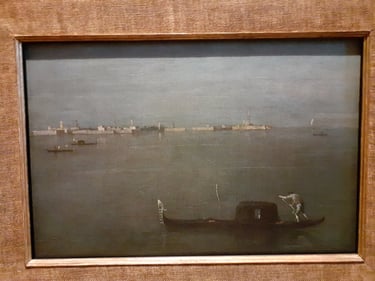
Will we be taking a gondola trip ?
Pepe Roncino
Yes ; it will be a gondola trip. The gondola is, of course, a mode of transport specific to Venice. However, in the years following 1674, real gondolas - gifted by the Republic of Venice to Louis XIV - plied the waters of the Grand Canal at Versailles. There were even Venetian gondoliers and "squeri" set up along the banks of the Grand canal, in an area known as "Little Venice"...
There has never been a genuine Venetian gondola on the Seine. However, Henri III - the only King of France to visit Venice - had gondola-like boats operated on the river.
Tintoretta
It is true that he had been very well received : I remember the painting in the Doge's Palace...
Pepe Roncino
It was just a century before the real gondolas of Versailles... But the greatest source of inspiration of a Gondola's Voyage on the Seine, is Balzac, who loved Venice dearly and chose it as the setting for his novel Massimilla Doni. Our gondola journey will therefore begin at the Maison de Balzac, Our Gondola's Voyage will therefore begin in Balzac's House, the one where he built his work, La Comédie Humaine.
Tintoretta
Dante, it's La Divine Comédie !
Pepe Roncino
That's a good point : here, too, balzac drew inspiration from Italy... He was also very fond of Florence, the birthplace of Dante Alighieri. the title of his novel, Massimilla Doni, was inspired by the name of Maddalena doni - the subject of a portrait by Raphaël on display in the Palatine Gallery at the Pitti Palace.
As for Venice, Balzac did not take to it immediately. On March 1837, he wrote to Countess Clara Maffei, a very young and lovely Milanese woman : "the marbles of Venice are an old woman who must once have been beautiful and who enjoyed all her advantages..." But he arrived there in the rain : "the rain draped Venice in a grey cloak- poetic, perhaps, for that poor city cracking at the seams and sinking hour by hour into the grave, but hardly pleasant for a Parisian who, for two-thirds of the year, enjoys that bounty of fog and that tunic of rain." Moreover, as early as March 19, he wrote to his Cara Contessina : "I have completely changed my opinion of beautiful Venice, which I find entirely worthy of its name." He also expressed his interest in the gondola for the first time : "the Venetian gondola is a world unto itself and makes me long to live in venice ; it is a marvelous invention that, so far, I have only been able to enjoy as a means of transport..."
We arrive at Balzac's House... He is located at number 47 on what is now rue Raynouard - known as rue Basse when Balzac moved in in October 1840. We are in the former village of Passy, which was annexed to Paris in 1860. Balzac lived there until April 1847. during this period, he wrote some of his finest novels : Une ténébreuse affaire, La rabouilleuse, Ursule Mirouët, Splendeurs et Misères des courtisanes, La Cousine Bette, Le Cousin Pons... He also revised the entire Comédie Humaine...
Tintoretta
How many novels make up the Comédie Humaine ?
Pepe Roncino
More than 90 works - but not just novels ; there are also novellas, short stories, and essays... Look at this chart : it outlines the structure of the work !


Tintoretta
This structure remains unfinished !
Pepe Roncino
Yes ! Despite the enormous body of work by Balzac, who died in 1850 at the age of 51.
Tintoretta
He died young !
Pepe Roncino
Yes - undoubtedly, in fact, because of his excessive workload. He had to churn out a great deal of writing to pay off his debts. The house had two entrances on two different streets, allowing him to flee from his creditors if the need arose...
Tintoretta
He was a hard worker !
Pepe Roncino
Yes ; more of a worker than an aesthete. That is criticism some - such as Flaubert - leveled at him : a style that lacked elegance. On the other hand, everyone acknowledged his immense creative power. And curiously, despite being a royalist, he was regarded - notably by Victor Hugo, Karl Marx and Friedrich Engels - as a "revolutionary" writer. This brings us back to our recurring theme of the Paris Commune.....
On the first day of the Paris Commune, March 18, 1871, the people prevented the removal of the cannons from the hills of Montmartre and Belleville. These cannons were in the hands of the National Guard. This National Guard, created by Lafayette to support the Revolution of 1789, had served as a supplementary force during the Franco-Prussian War. However, it was not docile like the regular army. As Michel Winock points out in his book La Commune, with the exception of those in the west and center (but no exception for the 15th), the Paris battalions were resistant to central authority. They had banded together in the Republican Federation of the Autonomous National Guard, led by a central committee. That is why the government wanted to disarm the National Guard - to appease Prussia, with whom it had concluded an armistice. Thus, around 3 a.m., thousands of regular army soldiers were sent to the various sectors of the city where the cannons were located : Belleville, les Buttes-Chaumont, la place d'Italie, la Bastille, le Luxembourg, les Invalides and the Butte Montmartre. It was on this hill that most of the cannons were stored. And it was Rue des Rosiers - now Rue du Chevalier-de-La-Barre - that the first incident broke out : a certain Turpin, who was guarding the cannons, was shot dead as he advanced toward the soldiers. This demonstrated the determination of the regular army. However, this one lacked a sufficient number of teams to haul the cannons down from the Butte. While other teams of horses are being driven up the hill, the population wakes up and crowds around the soldiers, seeking to fraternize with them. General Lecomte, who commanded the regiment, realizes then that the situation is slipping out his control. He makes the fateful decision tu use force : he orders the crowd protecting the cannons to withdraw. But the crowd do not budge. When he orders his soldiers to fire, however, they refuse to obey. It is now around nine in the morning ; General Lecomte and his officers are taken prisoner by members of the Republican Federation of the National Guard - known as the "fédérés"...
We're arriving at the îlot des Cygnes... This is where we'll begin our new Gondola's Voyage. Balzac is said to have envisioned a gondola service on the Seine. Even though no writings of his on the subject have ever been found, it wouldn't be surprising if he had indeed come up with the idea. In any case, the power of his imagination reinforced my own dream, and I'm happy to pay tribute to him...
Tintoretta
It's a brilliant idea ! It creates a link to our Gondola's Voyage in Venice.
Pepe Roncino
Yes ; and the 72-day duration makes sense : there are 37 bridges in Paris, and thus 36 intervals between them ; and there are two banks, making 72 sections ! !
Tintoretta
That's great !
Pepe Roncino
That said, we won't follow that mathematical logic to the letter - not all those sections would be worth visiting. The best approach is to start at the westernmost island, the Île aux Cygnes, and finish at the easternmost one, the île Saint-Louis - which Balzac called the "Venice of Paris". In between, we'll make stops at small harbors, with the longest break on the Île de la Cité...
Tintoretta
I really like the Île aux Cygnes : aside from the Statue of liberty, there isn't much there, but it's a peaceful spot !

